Salt Storage Buildings and Public Works Garages: Why Departments Are Switching to Closed-Cell Spray Foam
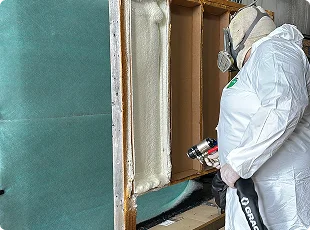
Every highway department has one: the salt building. It might be a wood-frame dome, a fabric structure, or a steel-frame shed with a concrete base, and it has the same problems in every version. The salt cakes because the building lets moisture in. The steel corrodes because the salt is hygroscopic and the air inside is never dry. The heated garage next door leaks warmth through an uninsulated metal roof and the plows start in the cold anyway. And when the department finally decides to insulate, someone buys fibreglass batts, which absorb the same moisture and fall out of the walls within a few winters.
Closed-cell spray polyurethane foam fixes the moisture problem and the insulation problem in the same pass, which is why public works departments across the upper Midwest are converting their salt sheds, plow garages, bus barns and pump houses. This article explains why it works, where it is applied, what it costs in practical terms, and the one code requirement that catches nearly every first-time buyer.
The real problem in a salt building is moisture, not temperature
Sodium chloride is hygroscopic: it pulls moisture out of the air. In an enclosed building, that moisture condenses on every cold surface — the underside of a metal roof, the steel frame, the door hardware, the loader parked inside overnight. That condensation carries dissolved salt, which is why the steel in a salt shed rusts faster than steel anywhere else on the property. It is also why the stored salt cakes into a mass that has to be broken up with the loader bucket before it can be spread.
Insulation in the conventional sense does not address this. Fibreglass and mineral wool are air-permeable; warm, moist interior air passes straight through them to the cold roof deck behind, condenses there, and soaks the insulation. Within a few seasons the batts are sagging, wet and worthless.
What closed-cell spray foam does differently
Closed-cell SPF is sprayed as a liquid and expands into a rigid, continuous layer bonded to the roof deck and walls. Applied at the right thickness it does three jobs at once.
It is an air barrier
The foam seals every seam, fastener and lap in a metal building. Moist interior air cannot reach the cold deck, so it cannot condense there. This is the single biggest change a department notices: the dripping stops.
It is a vapour retarder
Closed-cell foam at roughly 1.5 inches or more functions as a Class II vapour retarder — the cells are closed, so water vapour does not migrate through the foam the way it does through fibrous insulation. Verify the perm rating on the specific product's data sheet for your thickness.
It insulates — properly
Closed-cell SPF delivers on the order of R-6 to R-7 per inch (aged values vary by product — check the technical data sheet), so a two-inch application on a metal roof deck gives R-12 to R-14 with no thermal bridging at the purlins, because the foam runs continuously over them. The garage that used to lose its heat through the roof stops doing so.
It stiffens the structure
Bonded closed-cell foam adds racking strength and rigidity to metal panel buildings, which matters on the fabric and light-gauge structures that many salt sheds are.
Where to apply it — and where not to
In a salt storage building the foam goes on the roof deck and upper walls, above the level the loader and the salt pile reach. It does not belong on the lower walls where the bucket will hit it or where the pile leans; those surfaces are protected with a push wall or a polyurea coating instead, which is a different product doing a different job. In plow garages, bus barns and pump houses the foam covers the full envelope: roof deck, walls, and the rim and header areas where metal buildings leak the most air.
Products for this work are the closed-cell systems in the spray foam materials line — OR93BL and the NCFI HFO-blown systems such as InsulBloc and InsulStar — chosen for the temperature range the crew will be spraying in. Cold-weather application has its own rules; the guide on cold weather spray foam temperature limits covers them.
The requirement most first-time buyers miss: the thermal barrier
Spray polyurethane foam is combustible. Building codes — the International Building Code at section 2603 and the equivalent state codes adopted from it — require that foam plastic insulation inside a building be separated from the interior by an approved thermal barrier: typically half-inch gypsum board, or an intumescent coating tested and listed for the purpose. Unprotected foam on the inside of an occupied building is a code violation and a fire hazard, and the inspector will find it.
In a salt shed or plow garage, sheeting the whole roof deck in gypsum is impractical. The usual answer is a spray-applied intumescent thermal barrier coating such as No-Burn Plus ThB, applied over the cured foam by the same crew with the same kind of equipment. Whether a given building needs a full thermal barrier or the lighter ignition barrier permitted in some attic and crawl-space situations depends on occupancy and use; the article on thermal barriers and ignition barriers walks through the distinction. Confirm the requirement with your building inspector before the foam goes up, not after.
Doing it in-house versus hiring it out
A department with several buildings to insulate — salt shed, garage, pump houses, a park shelter — often finds the maths favours buying a rig. The same proportioner and gun that spray foam will spray polyurea, which opens up containment linings, lift station rehabilitation, bridge deck waterproofing and plow-truck bed liners with one piece of equipment and one trained crew. The municipal and public works page lays that out, including what the City of Tomah, Wisconsin buys to run its own spray foam operation. Departments that would rather hire the job should specify closed-cell foam at a stated thickness and the thermal barrier system explicitly, and ask the contractor for the product data sheets that will go in the file.
Frequently asked questions
How thick should the foam be on a salt shed roof?
Two inches of closed-cell is the common starting point: it delivers the air seal, the vapour retarder function and roughly R-12 to R-14. Heated garages in northern climates often go thicker on the roof deck. Match thickness to the building's use and the energy code that applies to it.
Will spray foam stop the salt from caking?
It stops the condensation that was dripping salt water back onto the pile and keeps the interior air drier. Salt still pulls moisture from the air that enters with the doors open; the improvement is large but ventilation and door discipline still matter.
Does the foam corrode or react with salt?
Cured polyurethane foam is inert to sodium chloride. What it does is keep the salt-laden moisture away from the steel behind it, which is the corrosion problem you actually have.
Can foam be applied to a fabric-covered structure?
Foam is applied to rigid decks and panels. Fabric structures are usually addressed with a liner system or by insulating the end walls and any rigid sections; ask before assuming.
Have a building on the list for this year? Send the dimensions, the construction type and the heating situation through the request form or call 800-625-9577, and we will size the material and talk through the thermal barrier requirement with you.